
What Is a Topographic Survey and When Do You Need One?
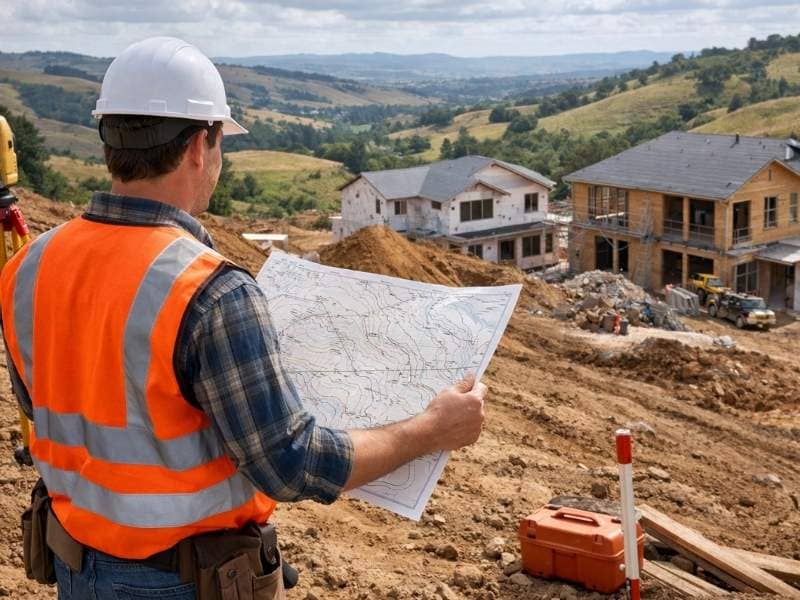
A topographic survey is a detailed map of a property’s surface. It records elevation changes, slopes, and physical features such as trees, buildings, and utility lines. Engineers and architects use this data to design buildings, plan grading, and manage water flow before building begins. Without it, design decisions are based on guesswork. And guesswork leads to costly problems in the field.
A topographic survey goes beyond where your property lines are. It answers a different question: what does the land look like, and how will that affect what you build?
What a Topographic Survey Captures
A topographic survey collects two types of information: elevation data and physical features.
Elevation data shows up on the final map as contour lines. Each line connects points at the same height. Lines close together mean a steep slope. Lines far apart mean flatter ground. Most home surveys use a one-foot or two-foot contour interval. Each line marks a one or two-foot change in height.
Physical features recorded during the survey include buildings, fences, driveways, trees, utility lines, drainage channels, streams, and retaining walls. Anything on or near the site that could affect design or building work is documented.
The final product is a topo map. Engineers and architects get both a printed version and a digital file. The digital file lets them build a 3D model of the land. They use that model to design grading plans, drainage systems, and building layouts.
Why This Data Matters for Building in Birmingham
Birmingham, Alabama has varied terrain. The area has rolling hills, ridges, creek corridors, and low spots with drainage challenges. That terrain directly shapes how sites are designed and built.
When an engineer gets a topographic survey, the elevation data shows where a building should sit on the lot. It also shows how much soil needs to move and how to grade the site so water drains away from structures. This process is called cut and fill.
The survey shows the current ground surface. The engineer designs the final surface. The gap between the two tells them how much earthwork the project needs. Getting this wrong is one of the most costly mistakes on a building project. Moving too much or too little soil adds time and money that were not in the budget.
Drainage matters just as much. Poor drainage leads to water pooling near foundations, erosion, and long-term damage. A topographic survey maps how water moves across the site. That gives engineers what they need to design systems that work with the land rather than against it.
When You Need a Topographic Survey
Not every project needs a topographic survey, but many do.
New home construction on a sloped or uneven lot. Flat lots in new subdivisions may not need one. Any site with a noticeable slope needs topographic data before design begins.
Site improvements and additions. Adding a garage, driveway, or pool may require topographic data if it changes the grading or drainage of the property.
Commercial and residential development. Projects going through the permit process in Jefferson County or Birmingham will often need a topographic survey as part of the site plan.
Drainage and flooding concerns. If a property has drainage problems or sits near a creek, a topographic survey records the current conditions. Engineers use that data to design a solution.
Land subdivision. When a parcel is divided, engineers need to know the terrain to plan roads, drainage, and utilities for each new lot.
How a Topographic Survey Is Done
Topographic surveys are done by a licensed land surveyor using field equipment and, in many cases, aerial tools.
Traditional ground surveys use GPS and robotic total stations to collect elevation points across the site. The crew records the height and location of each point. That data is then processed in the office into a contour map and terrain model.
For larger or heavily wooded sites, drone-mounted LiDAR is often used. LiDAR sends laser pulses toward the ground and measures how long they take to return. This captures ground elevations even through tree cover. Drone surveys collect large amounts of data quickly, making them a good fit for bigger or more complex sites.
Topographic surveys for home lots typically cost between $1,500 and $3,000. Larger or more complex sites range from $3,000 to $6,500 or more. For sites over two acres, drone surveys can cut costs by 30 to 50 percent compared to traditional ground methods.