
How Much Does a Property Survey Cost?
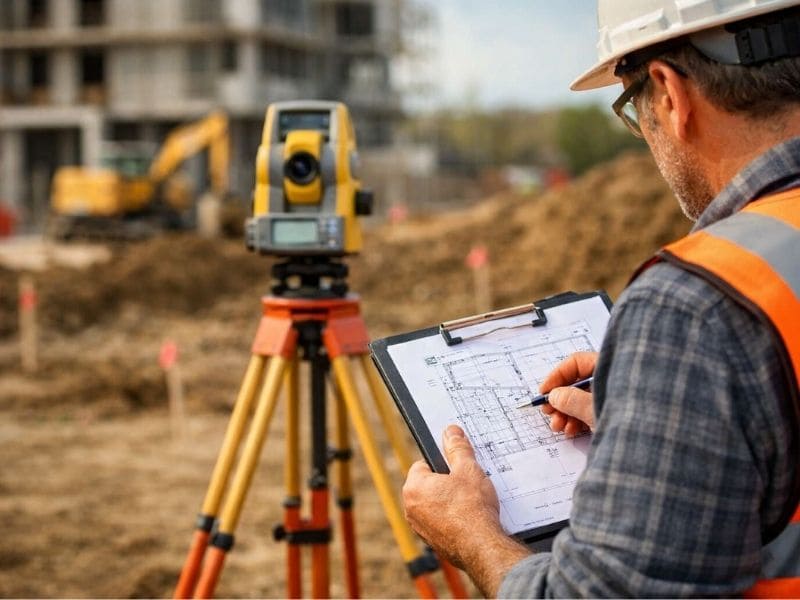
Property survey cost ranges from $300 to $5,000 or more, depending on property size, terrain, survey type, and the condition of existing records. Most residential boundary surveys fall between $500 and $1,500. Commercial surveys run higher.
If you’re buying land, settling a boundary dispute, or pulling a building permit, knowing what to expect before you get the quote saves you from sticker shock. Here’s what actually drives the price.
Factors That Influence the Cost of a Property Survey
A surveyor’s time is the main input. Anything that adds hours to the job adds cost, and several things do.
Size is the most direct factor. A quarter-acre city lot wraps up faster than a 10-acre rural tract. More ground means more field time, more measurements, and more office work to process everything afterward.
Terrain is the one people underestimate. A flat subdivision lot is straightforward. A wooded hillside with a creek running through it is not. Some jobs take twice as long simply because of what’s on the ground.
Records matter more than most buyers realize. If the county has a clean survey on file from 15 years ago, the surveyor starts ahead. If the last recorded plat is from 1952 and the deed references a fence post that no longer exists, research alone can eat up a full day.
Access is the quiet wildcard. A property with a locked gate, an easement dispute, or terrain that requires equipment beyond a standard truck will cost more to reach and document.
Why Different Survey Types Have Different Price Ranges
Not all surveys serve the same purpose, and the level of detail required drives the price more than almost anything else.
A boundary survey is what most residential buyers and homeowners need. It confirms property lines and establishes legal corners. For a standard residential lot, it typically costs between $300 and $1,500.
A topographic survey goes further. It maps elevation changes, drainage patterns, and physical features across the land. Builders and engineers order these before breaking ground. Cost usually falls between $500 and $2,000, though larger or complex properties push that higher.
An ALTA/NSPS survey is the most detailed option. Lenders and title companies require it for complex transactions because it meets nationally standardized specifications. Cost runs from $2,000 to $5,000 or more, sometimes considerably higher for larger parcels.
The price difference isn’t arbitrary. An ALTA survey demands more research, more field time, and a licensed surveyor who signs off on far stricter deliverables than a basic boundary check requires.
How Property Features Can Raise Survey Expenses
Certain site conditions make the work harder, and that shows up in the final bill.
Wooded lots are the most common complication. Before measurements can even start, the crew has to cut sight lines through trees and brush. That’s preparation, not surveying. It still takes time.
Irregular lot shapes, odd angles, and curved boundaries require more calculation. A standard rectangle is simple. A 12-sided irregular parcel takes longer to close mathematically.
Water features, including streams, ponds, and drainage easements, affect where legal boundaries fall. Figuring out that relationship requires analysis beyond standard fieldwork.
Missing property monuments create a different kind of delay. When the corner markers that define a boundary are gone or disturbed, the surveyor has to reconstruct their position from older records and neighboring evidence before the main work can begin. That adds hours before a single measurement is taken.
Steep slopes slow every part of the process and sometimes require specialized equipment. If several of these conditions exist on one property, the quote will reflect all of them.
What’s Included in the Price of a Professional Land Survey
The field visit is the visible part of a survey. Most of the work happens before and after it.
Before the crew arrives, the surveyor pulls deeds, reviews historical plats, and examines county records to piece together the legal history of the parcel. For older or complicated properties, this stage takes as long as the fieldwork itself.
On-site, the crew measures distances, checks angles, locates existing monuments, and collects the raw data needed to establish or confirm boundary lines.
Back in the office, that data gets analyzed and drafted into a plat or survey map. That’s the legal drawing showing the property’s boundaries, dimensions, and any easements or encroachments. Many surveys also include a written legal description, which is used in deeds, permits, and title insurance policies.
That’s what property survey cost actually buys. Not a quick walk around the yard.
How to Budget for a Property Survey Before Buying or Building
Order early, come prepared, and confirm what type of survey is actually required before you schedule anything.
When you contact a surveyor, have the property address, approximate acreage, the purpose of the survey, and any known issues ready. Disputed lines, missing monuments, access restrictions the more detail you give up front, the more accurate the quote will be.
Get at least two quotes. Prices vary between firms, and comparing a few gives you a realistic sense of what the job should cost for your specific property.
One step many people skip: check with your lender or local building department before ordering. Some transactions require a specific survey type. Paying for the wrong one means paying twice.
Frequently Asked Questions
How much does a property survey typically cost?
Most residential surveys fall between $300 and $2,000. Boundary surveys for standard lots tend to land between $500 and $1,500. ALTA/NSPS surveys for commercial transactions often exceed $5,000.
What factors affect the price of a property survey?
The main drivers are property size, survey type, terrain difficulty, the quality of existing records, and site accessibility. Any condition that adds time to the job adds to the cost.
Does property size affect survey cost?
Yes. Larger parcels take more time in the field and more time in the office to process. Size is consistently one of the biggest cost variables, though it’s rarely the only one.
Can difficult terrain or missing markers raise the cost?
Yes, and sometimes by a significant amount. Wooded land, steep slopes, water features, irregular boundaries, and missing or disturbed monuments all add time. In some cases, these complications can double the base cost of a standard survey.
What does the cost of a professional property survey include?
It covers records research, field measurements, boundary analysis, and preparation of a legal plat or survey map. Most surveys also include a written legal description for use in deeds, permits, and title documents.